
The Best Supplement Tracker Apps in 2026, Compared
We compared six popular supplement tracker apps on their documented features — label and barcode scanning, ingredient-overlap detection, dosage totals, timing and interaction guidance, and AI analysis — using each company's own published materials. Here's what each one is built for, and who should pick something else.
Disclosure: StackIQ (made by Axon Technologies, LLC) publishes this comparison and is included in it. This is a documented-feature comparison: every claim comes from each app's website, App Store or Google Play listing, or help pages, checked on the dates in the Sources and dates table. We did not run a controlled hands-on test and we don't assign scores. Where another app is the better fit, we say so.
Quick verdict
StackIQ has the most complete documented feature set for understanding a multi-product supplement routine. Of the six apps compared, it is the only one whose published materials describe barcode and Supplement Facts label scanning, ingredient-level totals with overlap detection, medication considerations, reminders, wellness check-ins, and an AI assistant that works from the user's own stack.
StackIQ is available on both iPhone and Android.
One honest caveat up front: StackIQ is not the best app for every job. If your main problem is remembering prescriptions, Medisafe is stronger. If you only want a free reminder, MyTherapy costs nothing. The comparison below explains where each app wins.
The distinction that shapes this comparison: most tracking apps help you remember what to take. StackIQ is built to help you understand what you're taking.
Want to see what your supplement routine adds up to? Scan your bottles, track your daily routine and review ingredient overlaps with StackIQ.


In this guide:
- How we compared
- Comparison table
- StackIQ
- SuppCo
- Cronometer
- Medisafe
- MyTherapy
- Round Health
- Best app by use case
- FAQs
- Sources and dates
How we compared
We looked for the same seven things in every app, using only what each company publishes about its own product. Because this guide is about understanding a multi-product routine, the first four matter most — they are what separate a supplement tracker from a generic pill reminder.
- Supplement-specific intelligence — does the app treat a supplement as a formula (ingredients, amounts, forms) rather than a generic "pill"?
- Overlap and dosage analysis — ingredient totals across all products; duplicate-ingredient detection.
- Scanning and setup — barcode scanning, Supplement Facts label scanning, manual entry.
- Timing and interaction guidance — timing considerations; supplement–medication flags.
- Daily tracking — logging, reminders, schedules, streaks.
- Privacy and transparency — a clear privacy policy; whether health data is sold or shared with advertisers.
- Price and availability — free-tier usefulness, paid price, platforms.
Sources: each app's official website, App Store and Google Play listings, and help documentation, checked on the dates in the Sources and dates table. Where a company doesn't document a capability we treat it as not offered and say so. If you know otherwise, email support@getstackiq.com with a link and we'll correct the table.
Comparison table
| App | Best for | Label scanning | Overlap detection | Interaction flags | AI insights | Wellness tracking | Price |
|---|---|---|---|---|---|---|---|
| StackIQ | Understanding your whole stack | ✅ Barcode + Supplement Facts label | ✅ Ingredient-level totals | ✅ Supplement–medication | ✅ Stack-aware AI chat (Pro) | ✅ Sleep, energy, focus, mood check-ins | Free · Pro $4.99/mo or $39.99/yr |
| SuppCo | Product quality ratings | ✅ Barcode (160,000+ products) | Partial (routine rated, not ingredient totals) | Not documented | Partial (AI chat on timing; StackScore) | Not documented | Free · Pro $39.99–$59.99/yr |
| Cronometer | Food + supplement micronutrients | Not documented for supplement labels | Partial (nutrient totals: 84 free, 95 Gold) | Not documented | Partial (Crono Coach, Gold) | ✅ Biometrics | Free (ads) · Gold $10.99/mo or $59.99/yr |
| Medisafe | Prescription adherence | Not documented | Not documented | ✅ Drug–drug warnings | Not documented | ✅ Measurements (glucose, BP, weight, pulse, temperature) | Free (limited) · Premium (varies by plan; see sources) |
| MyTherapy | Free reminders + health journal | Not documented | Not documented | Not documented | Not documented | ✅ Measurements, symptoms, mood | Free |
| Round Health | Simple iOS reminders | Not documented | Not documented | Not documented | Not documented | Not documented | Free |
"Not documented" means the company's own materials didn't describe the capability when we checked. Competitor prices are as listed on the dates in the Sources table and vary by region and plan.
StackIQ — most complete for stack-level analysis
Best for: People who want one app to scan, organize, track and better understand their complete supplement and medication routine.
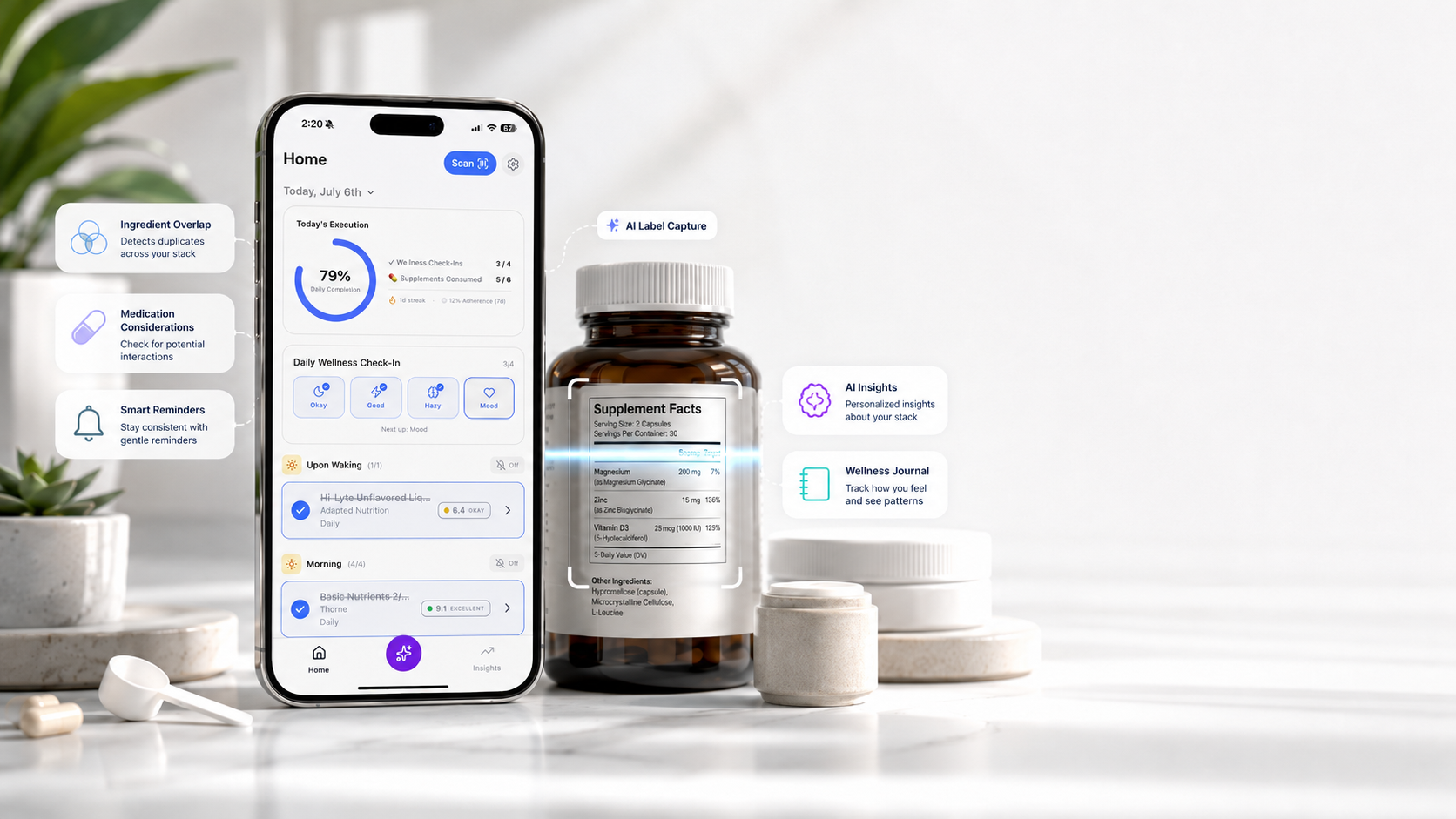
StackIQ goes beyond basic pill reminders. It combines supplement capture, ingredient-level analysis, medication considerations, reminders, wellness check-ins and personalized AI guidance in one app.
What StackIQ does well
Three ways to add supplements
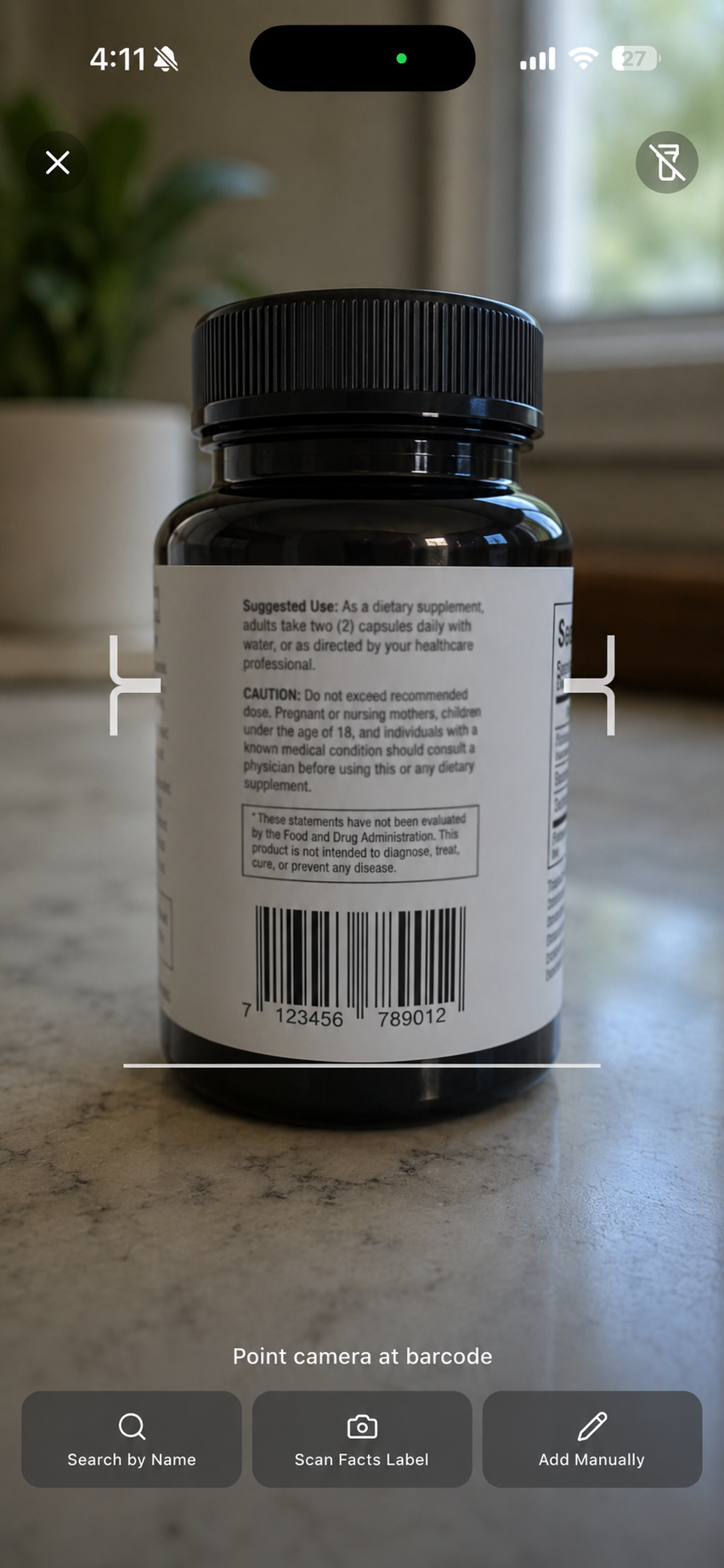
StackIQ gives users several ways to add a product:
- Scan its barcode
- Photograph the Supplement Facts label
- Search by name or enter the product manually
Barcode scanning is the fastest option when the product is already recognized. When a barcode is unavailable, outdated or not found, users can photograph the label instead — which makes it possible to add smaller brands, newly released products and formulas that aren't in a standard barcode database. Check the extracted values against the label before saving.
Ingredient-level dosage and overlap analysis
StackIQ breaks products down into their individual ingredients rather than treating each bottle as a generic pill.
It can help users see:
- The total amount of an ingredient across their routine
- Ingredients that appear in several products
- Potentially overlooked overlaps
- The contribution of each product to the combined daily total
- Differences between serving sizes and the user's actual schedule
For example, magnesium could appear in a multivitamin, electrolyte powder, sleep formula and standalone magnesium product. StackIQ brings those sources together so the user can understand the complete total.
Supplement and medication considerations
StackIQ allows users to add medications alongside supplements. Supplement–medication pairs are checked against a curated interaction reference, and the app uses AI to explain each flag in plain English.
It can then surface possible:
- Supplement–medication interactions
- Timing considerations
- Combinations that may deserve closer attention
- Questions to discuss with a physician or pharmacist
These flags are educational. They do not diagnose an interaction or instruct users to start, stop or change a medication, and the absence of a flag is not a guarantee of safety. Their purpose is to help users identify considerations they may otherwise miss and ask better-informed questions.
Reminders and daily intake tracking
StackIQ also handles the practical side of following a routine.
Users can:
- Create morning, bedtime or custom schedules
- Receive reminders
- Log whether products were taken
- Track consistency over time
- Review their daily routine
This means users do not need one app for reminders and a separate app for supplement analysis. The same app that understands the ingredients also helps the user remember the routine.
Wellness check-ins
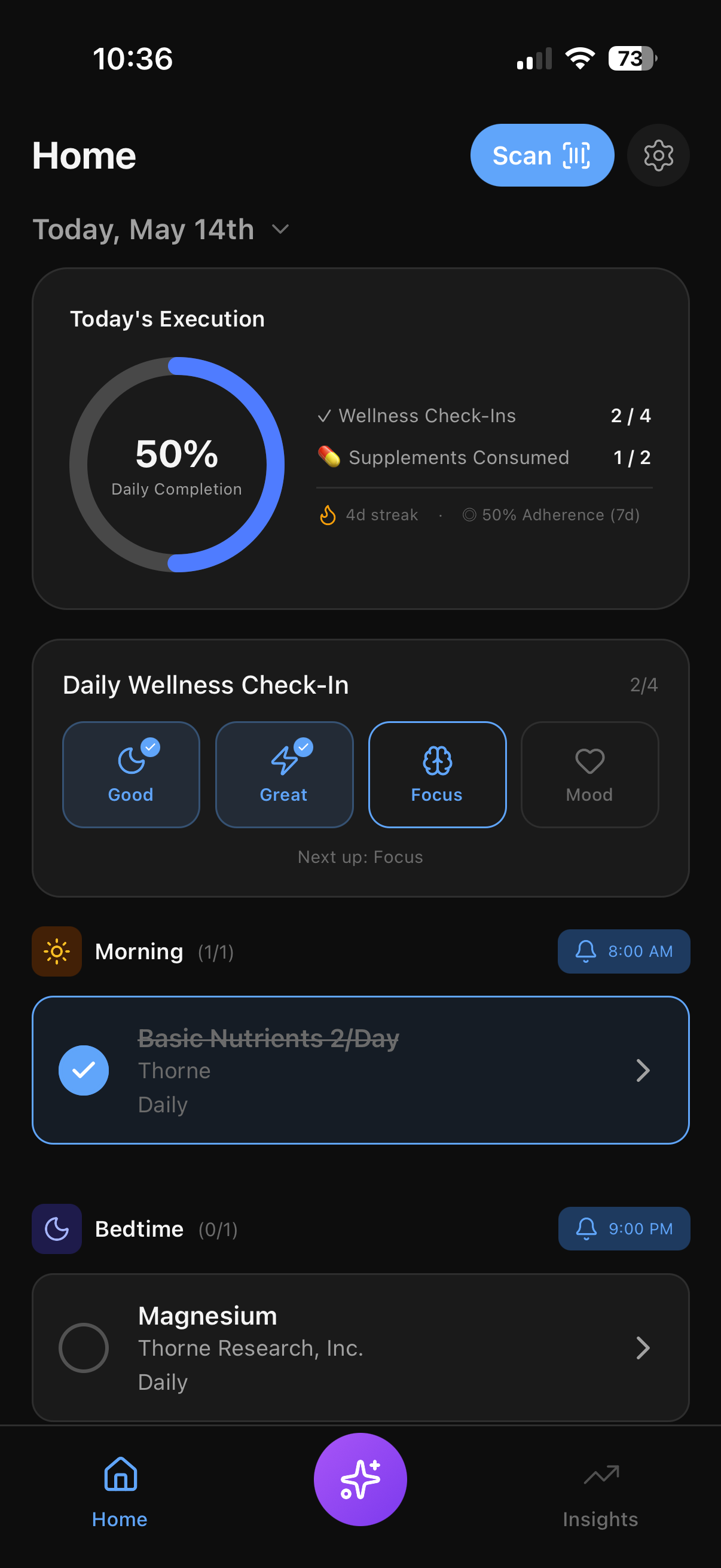
StackIQ lets users record how they feel alongside what they take, with daily check-ins for:
- Sleep
- Energy
- Focus
- Mood
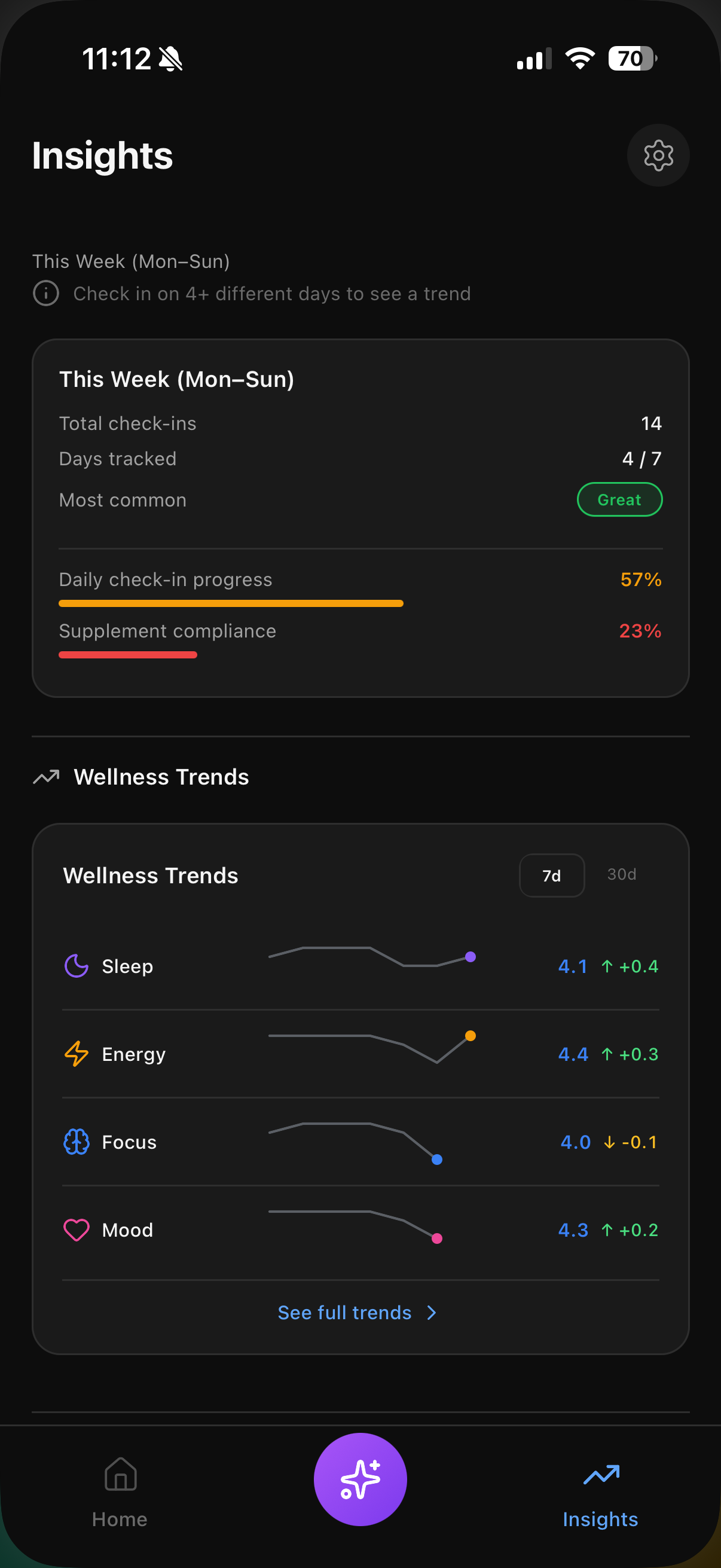
Weekly trends show how each one is moving. This does not prove that a supplement caused a particular outcome; it gives users a structured timeline they can review for patterns, changes and questions worth exploring.
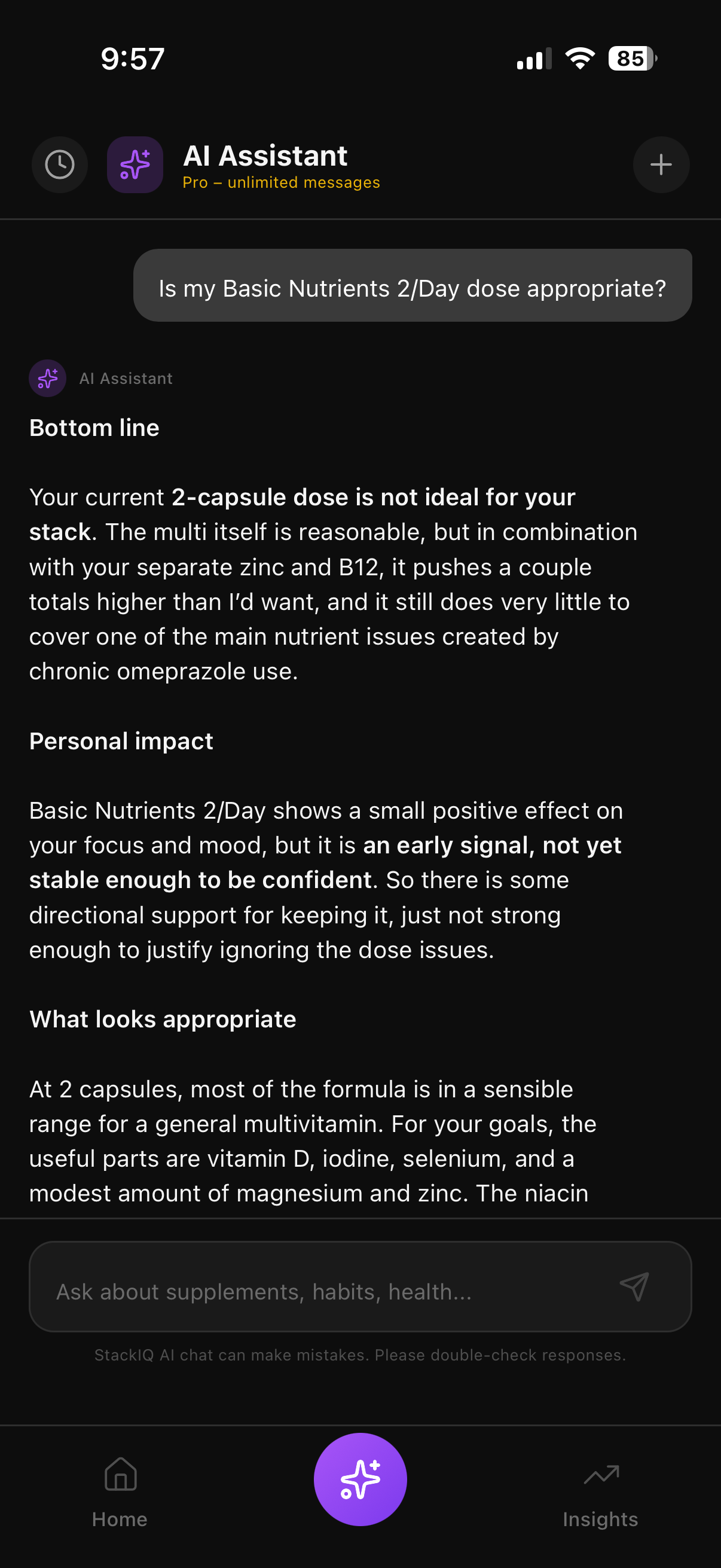
AI grounded in the user's complete routine
StackIQ's AI assistant (unlimited with Pro) can use the context the user has recorded, including:
- Supplements
- Individual ingredients
- Dosages
- Schedules
- Medications
- Goals
- Wellness check-ins
This allows users to ask personalized questions such as:
- "Am I getting magnesium from more than one product?"
- "Are there any considerations between my supplements and medications?"
- "Which products in my stack are usually taken with food?"
- "What changed in my routine when my sleep check-ins improved?"
- "What questions should I ask my pharmacist about this stack?"
A general chatbot does not automatically know the user's exact products, doses, medications or check-in history. StackIQ's advantage is that the relevant context is already organized inside the app. AI answers can still be wrong or incomplete; the app says so on every response.
Where StackIQ fits
StackIQ's documented features cover the complete supplement-management workflow:
- Capture products through barcode scanning, Supplement Facts label scanning or manual entry.
- Organize the routine at both the product and ingredient level.
- Calculate totals and identify overlaps across multiple supplements.
- Surface timing and medication considerations.
- Deliver reminders and track daily adherence.
- Connect the routine with wellness check-ins.
- Provide personalized AI insights grounded in the user's own data.
Other apps are stronger in one specialized category. SuppCo is particularly strong for product-quality research, Cronometer for food and nutrient tracking, and Medisafe for complex prescription adherence.
StackIQ is the most complete choice for someone who wants all the major parts of supplement management in one place.
Most apps either remind you what to take or provide information about individual products. StackIQ helps you capture, track and understand your entire routine.
StackIQ limitations
- AI insights, unlimited AI chat and advanced analytics require StackIQ Pro.
- Medication and supplement information must be kept accurate by the user.
- Check label-scan results against the bottle before saving.
- Interaction flags are educational and should be reviewed with a qualified healthcare professional.
- Wellness check-in patterns show associations, not proof of causation.
Pricing: Free tier includes the stack tracker, label scanner, dosage & timing tracking, and ingredient-overlap detection. Pro is $4.99/month or $39.99/year and adds AI-powered insights, unlimited AI chat, and advanced analytics. Pricing →
Choose StackIQ if:
- You want barcode and Supplement Facts label scanning
- You take several supplement products
- You want reminders and intake tracking
- You want total ingredient dosages across your stack
- You want duplicate-ingredient detection
- You take medications alongside supplements
- You want timing and interaction considerations
- You want to check in on sleep, mood, energy or focus
- You want AI answers based on your actual routine
Ready to see your whole routine in one place?
SuppCo — best for product-quality research
Best use case: deciding which brand of a supplement to buy, with stack organization built in.
Strengths: SuppCo combines product-quality ratings with routine analysis, expert protocols, scheduling, reminders and daily intake tracking. Its TrustScore rates products on quality attributes across a database the App Store listing describes as "over 160,000 supplements" (the website headline now says 230,000+). A barcode scanner is documented, as is AI chat about supplement timing. Available on iOS and Android.
Limitations: SuppCo's center of gravity is product quality and goal coverage rather than stack-level analysis. Its published materials don't describe Supplement Facts label scanning, ingredient-level totals with overlap analysis, supplement–medication considerations, or wellness check-ins. Some analysis and scan features require Pro.
Pricing: free; Pro membership listed at $39.99 and $59.99 per year on the App Store.
Choose SuppCo if your main question is "is this brand any good?"
Cronometer — best for micronutrient tracking across food and supplements
Best use case: people who want their supplement intake in the same ledger as their diet.
Strengths: unmatched nutrient depth — up to 84 tracked nutrients on the free tier and 95 on Gold, against lab-analyzed food data. If you want to know your total magnesium from food plus pills, Cronometer is the most rigorous way to do it. Gold adds Crono Coach (an AI assistant), custom charts, custom biometrics and ad-free tracking.
Limitations: it's a nutrition tracker first. Its materials don't describe supplement label scanning, interaction guidance or timing analysis, and logging supplements is more manual than scanning a bottle.
Pricing: free tier (with ads); Gold is $10.99/month or $59.99/year.
Choose Cronometer if you're optimizing diet and supplements together and don't mind manual entry.
Medisafe — best for medication adherence
Best use case: managing prescriptions, with supplements along for the ride.
Strengths: the most mature reminder system in this comparison — complex dose schedules, refill reminders, family/caregiver sync, measurement tracking (blood glucose, blood pressure, weight, pulse, temperature), and drug-to-drug interaction warnings described on its App Store listing.
Limitations: supplements are treated as generic pills — no label scanning, ingredient-level view or overlap detection is documented. Third-party reports in 2026 describe the free tier as capped at two medications with interaction warnings behind Premium; Medisafe's own listing doesn't state a cap, so treat the limit as reported rather than confirmed.
Pricing: free (limited); Premium in-app purchases listed at $2.99–$9.99/month and $27.99–$39.99/year depending on plan.
Choose Medisafe if prescription adherence is the problem you're solving; it's better at that than StackIQ.
MyTherapy — best free option
Best use case: reliable, genuinely free reminders with a health journal.
Strengths: "always has been and always will remain free," in the company's words, on iOS and Android. Solid reminders, automatic intake documentation, refill alerts, and a journal (measurements such as blood pressure and weight, symptoms, mood) with reports you can share with a doctor.
Limitations: no scanning, ingredient awareness, overlap detection, or interaction or timing guidance is documented. A supplement is just a named pill.
Choose MyTherapy if you want zero-cost reminders and adherence history, nothing more.
Round Health — best for simple iOS reminders
Best use case: the minimalist who wants attractive, persistent reminders on iPhone and Apple Watch.
Strengths: flexible scheduling with reminder windows, an Apple Watch app with complications, streaks, refill reminders. Free.
Limitations: reminders are the whole product — no scanning, analysis, interactions, or insights are documented.
Choose Round Health if you take one or two products and just want a nudge.
Best supplement tracker by use case
- Most complete stack analysis: StackIQ — scanning + overlap detection + dosage totals + interaction considerations + wellness check-ins + stack-aware AI
- Best for simple reminders: Round Health (iOS)
- Best for medication adherence: Medisafe
- Best free option: MyTherapy
- On Android: StackIQ, SuppCo and MyTherapy all have Android apps; Round Health is iPhone-only
- Best for brand/quality research: SuppCo
- Best for food + supplement nutrient math: Cronometer
FAQs
What is the best app for tracking supplements? It depends on the job. For understanding a full routine — doses, overlaps, timing, and medication considerations — StackIQ has the most complete documented feature set. For simple reminders, MyTherapy (free) or Round Health (iOS) are better fits.
Is there an app that scans supplement labels? Yes. StackIQ scans both barcodes and the Supplement Facts label itself, which matters because many supplements aren't in barcode databases. SuppCo scans barcodes against a database of 160,000+ products.
Can an app detect duplicate vitamins? StackIQ detects duplicate ingredients across products — e.g., magnesium appearing in a multivitamin, a sleep formula, and an electrolyte mix — and totals the combined dose.
Can a supplement app check medication interactions? StackIQ surfaces possible supplement–medication considerations based on the medications you enter, using a curated interaction reference with AI-written explanations; the flags are educational and should be reviewed with a doctor or pharmacist. Medisafe checks drug–drug interactions but doesn't analyze supplement ingredients.
How do I track total dosage across several supplements? You need ingredient-level tracking, not pill-level. StackIQ totals each ingredient across every product in your stack; Cronometer can do nutrient totals if you log everything manually alongside food.
Is StackIQ free? Yes — the free tier includes the stack tracker, label scanner, dosage & timing tracking, and ingredient-overlap detection. Pro ($4.99/month or $39.99/year) adds AI insights, unlimited AI chat, and advanced analytics.
Does StackIQ work on Android? Yes. StackIQ is available on Google Play for Android and on the App Store for iPhone.
Can AI analyze my supplement stack? Yes. StackIQ's AI assistant answers questions grounded in your actual stack, goals, medications, and check-ins — a different thing from asking a general chatbot, which doesn't know what you take. AI answers can be wrong; double-check anything you act on.
Honest limitations & disclosures
- StackIQ does not diagnose conditions or replace a clinician. The app's own framing: it's a guide, not a doctor.
- Interaction flags are educational. Review anything flagged with a doctor or pharmacist.
- Medication information in StackIQ is entered by the user; the analysis is only as complete as the list you provide.
- Some advanced functions require StackIQ Pro.
- StackIQ states that health data is not sold to advertisers.
- This comparison is based on each app's published features and documentation as of the dates below. Competitor pricing and features change; we'll update this page as they do.
Track your stack, spot the overlaps, and get answers grounded in what you actually take.
Sources and dates
| App | Claim | Source | Date checked |
|---|---|---|---|
| StackIQ | Feature list, free vs Pro, $4.99/mo and $39.99/yr | getstackiq.com/pricing; App Store listing (id6759578140) | 2026-09-21 |
| StackIQ | Available on Android | Google Play listing (com.getstackiq.app) | 2026-10-02 |
| SuppCo | "over 160,000 supplements"; barcode scanner; TrustScore; smart schedule and reminders; AI chat on timing; Pro $39.99 and $59.99 | App Store listing (id6504838951) | 2026-09-21 |
| SuppCo | "230,000+" products headline; "free to all users"; 80+ expert protocols; iOS and Android | supp.co | 2026-09-21 |
| Cronometer | 84 nutrients free / 95 Gold; Gold $10.99/mo or $59.99/yr; ad-free with Gold; Crono Coach | cronometer.com/gold | 2026-09-21 |
| Medisafe | Drug-to-drug interaction warnings; family sync; measurements tracked; Premium $2.99–$9.99/mo, $27.99–$39.99/yr | App Store listing (id573916946) | 2026-09-21 |
| Medisafe | Free tier capped at two medications; interactions behind Premium | Third-party reports (e.g. pillo.care); not stated on Medisafe's listing | 2026-09-21 |
| MyTherapy | "always has been and always will remain free"; reminders, intake documentation, refill alerts, measurements and mood, doctor reports | mytherapyapp.com | 2026-09-21 |
| Round Health | Apple Watch app and complications; refill reminders; streaks; free; iPhone | App Store listing (id1059591124) | 2026-09-21 |
About this guide
- Written by
- Nico Ravelli
- Published
- July 6, 2026
- Last updated
- October 2, 2026
This guide was written and edited by a person. It reflects published product information on the dates stated; features and prices change. Spotted an error? Email a correction · How StackIQ content is made